

How High Is 1000 Feet
Most airline passengers simply have the fact that passenger jets wing very high. They rarely enquire about it, or want to know what altitude is used. But at that place are good reasons for how high planes fly.
In fact, the common cruising altitude for nigh commercial airplanes is between 33,000 and 42,000 feet, or between nigh vi and near viii miles to a higher place bounding main level. Typically, aircraft fly effectually 35,000 or 36,000 feet above sea level. This is why when you are on a long flying, you lot will generally hear the helm say something like, "Ladies and gentlemen, we have now reached our cruising altitude of 36,000 anxiety".
Commercial airplanes tin theoretically fly a lilliputian higher than this, and of grade they can also fly lower if they choose to. But small shipping such every bit those flown by private pilots cannot fly this loftier, and usually do not become above 10,000 anxiety. Indeed, they oftentimes wing much lower than this.
There are a number of reasons for all of the higher up, which we will accept a wait at now.
Fuel Efficiency
The main reason for airliners flying and so high is that information technology saves fuel and therefore saves money, which is e'er a priority for airlines. The air becomes thinner as the altitude increases, and sparse air creates less elevate on the aircraft. In addition, jet engines operate more efficiently at high altitudes, meaning the airplane can travel faster while at the aforementioned time burning less fuel.
However, a plane'south engines demand oxygen in order to function, so flying too high can also cause issues. Plus if a plane goes higher, information technology has to fire more than fuel in order to go at that place. And then there has to be a balance, which is the reason for the fairly specific altitudes generally used by airliners. 35,000 feet or thereabouts is the distance at which fuel efficiency is greatest, while in that location is withal enough oxygen available to power the engines.
Avoiding Traffic and Other Hazards
Flying higher ways that commercial airplanes can avoid most other airborne traffic. At the altitudes they use, at that place will exist no lite aircraft and helicopters, and no drones, which all wing much lower.
Birds rarely fly that loftier, which is of import, as bird strikes, though rare, can be disastrous if they happen. An extreme case of this sort of disaster was the US Airways shipping which was forced to land on the Hudson river after a bird strike. This sort of thing is extremely unlikely, but information technology does happen occasionally.
Weather and Turbulence
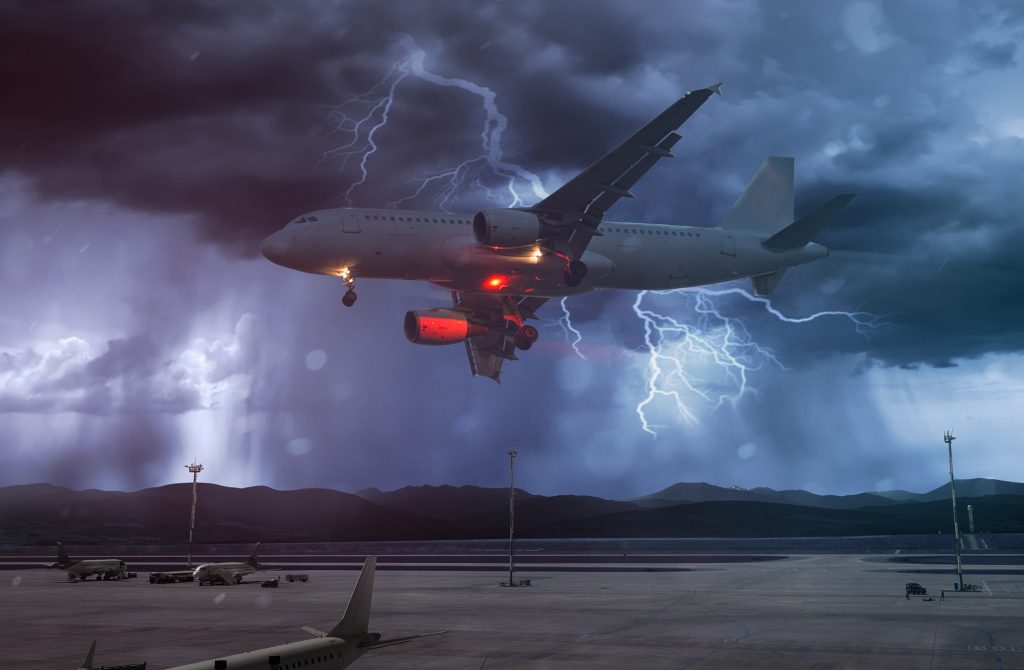
It is not essential for aircraft to avert bad weather condition, just it is a expert idea. Commercial airplanes ordinarily fly higher up the troposphere, which is the office of the atmosphere where atmospheric condition events usually happen. The troposphere is normally said to stop at 36,000 anxiety. This is why when you are cruising in an airliner, it is normally brilliant and sunny, with all the cloud and pelting beneath you.
Turbulence is less mutual at high altitudes too. Again, airliners can generally cope with turbulence, but it is preferable to avoid information technology if possible.
Safely Factors
Over 42,000 flights have place every day, with 5,000 planes in the heaven at any one time, co-ordinate to the FAA. With this much traffic, there has to be some official arrangement to make certain collisions practise not happen, and there is.
There are certain rules for exactly where airliners can fly, and the direction of travel tin affect what distance they will climb to. Planes flying east, including northeast and southeast, volition fly at odd altitudes, such as 35,000 feet. Planes flight in approximately westerly directions have to fly at even altitudes. This ways that planes flying in opposite directions to each other are at least 1000 anxiety apart, then avoiding a possible collision and making for safer flights.
Emergencies
Lastly, flying high gives you more fourth dimension to act in the unlikely upshot of an emergency in flying. Mod airliners are incredibly safe near of the time, but should something happen which means an emergency landing is required, high altitude gives the pilots much longer to sort things out and find a safe place to land.
On the other manus, flying as well high could have negative safety issues. In some emergencies, such as a rapid decompression, pilots want to return to a lower distance as quickly every bit possibe. Then again, there has to be a balance, which accounts for the altitudes generally used.
A Word About Light Aircraft
While jet engines operate well at high altitudes, the same is not truthful of piston engines, which are typically used for light aircraft of the blazon flown past most private pilots. Piston engines do non operate well in sparse air, and this is one of the reasons why nearly minor planes fly at altitudes of below fifteen,000 feet.
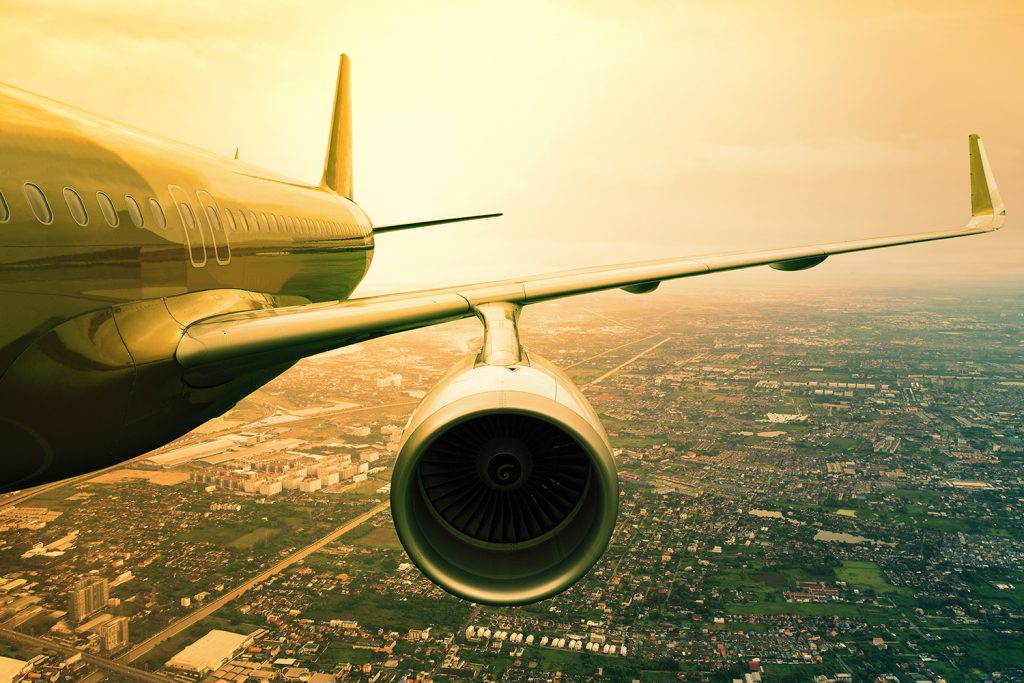
But in fact, small aircraft more often than not fly much lower than that for a variety of other reasons. This is partly considering they tend to fly shorter distances, and pilots simply do not want to spend likewise much time climbing and descending on a short flight; it just isn't worth it. Also, most minor planes are not equipped with oxygen, which would be necessary if they were to fly too loftier. It is probably non really condom for them to be much above 10,000 anxiety. And a substantial bulk of small planes are flown for recreational purposes, and pilots savor flying lower, where they can run across things below them. This is not a factor in commercial flying.
Withal, legally planes must be at least g anxiety above any object on the ground, and must be able to land articulate of any congested area in the effect of an engine failure. Therefore pocket-sized planes generally fly betwixt 2000 and 10,000 feet. It all makes sense when y'all know the reasons for it!
And Finally…
It should be noted that every airplane has a certified maximum altitude. During exam flights this maximum is exceeded slightly to verify the that airplane remains safe should information technology have cause to ascend from that limit. The highest certified altitude of an airliner was Concorde's 60,000 feet. Today some of the corporate jets tin wing at 51,000 feet.
However, for all the reasons mentioned above, this is mainly theoretical, and most commercial airplanes fly much lower than this.

How High Is 1000 Feet,
Source: https://pilotinstitute.com/airplane-height/
Posted by: gerbersuppin.blogspot.com
0 Response to "How High Is 1000 Feet"
Post a Comment